
Most Raleigh homeowners spend time thinking about their HVAC system, their roof, their foundation. Very few think about radon — an invisible, odorless gas that forms naturally in the soil beneath their home, seeps upward through foundation gaps and crawl spaces, and accumulates in living areas without any detectable sign until a test reveals it.
Radon is the second leading cause of lung cancer in the United States, responsible for approximately 21,000 deaths per year according to the EPA. It affects new homes and old ones, well-maintained homes and neglected ones, homes in cities and in the country. And in North Raleigh — particularly in the neighborhoods north of I-540 and along the Wake Forest Road corridor — the local geology creates conditions worth understanding.
If you own a home in North Hills, Sawmill Road, Durant Road, Falls of Neuse, Wakefield, Stonehenge, Greystone, or anywhere along the Wake Forest Road corridor toward Wake Forest, here is what you should know about radon — and what to do about it.
Radon levels vary significantly from house to house — even on the same street. The only way to know your home’s radon level is to test it. LiveGreen provides professional radon testing throughout the Raleigh area.
What Radon Is — and Why It’s a North Carolina Issue
Radon is a naturally occurring radioactive gas produced by the decay of uranium and radium in soil, rock, and groundwater. It is present in virtually all soils to some degree — the question is how much accumulates in any given home, which depends on the geology beneath the property, the construction of the foundation, and how airtight the home is.
North Carolina sits in a geologically varied region. The western part of the state — the Blue Ridge and Piedmont — contains significant deposits of granitic and metamorphic rocks that are naturally higher in uranium and radium, which produce more radon than the coastal plain geology to the east. Raleigh sits in the Piedmont zone, specifically on or near the Carolina Slate Belt and the Triassic Basin, geological formations that have produced measurable radon readings across Wake County.
Wake County is not among North Carolina’s highest-radon counties — that distinction belongs to counties in the western mountains and foothills. But “not the highest” is not the same as “not a concern.” North Carolina data consistently shows elevated readings in individual homes across Wake County, and the EPA’s action level of 4 picocuries per liter (pCi/L) is reached in a meaningful percentage of homes tested here — including in the north Raleigh and Wake Forest Road corridors specifically.
Why North Raleigh and Wake Forest Road Deserve Particular Attention
Radon risk isn’t uniform across a county or even across a neighborhood. It is intensely local — driven by the specific geology beneath an individual lot, the type and condition of the foundation, and how the home is ventilated. But within the broader Wake County picture, several factors make the north Raleigh and Wake Forest Road corridor worth paying attention to.
The geology along the Wake Forest Road corridor and into northern Wake County transitions through several rock types — including zones associated with the Rolesville Batholith, a large granitic body that underlies portions of northern Wake and Franklin counties. Granitic rock is among the rock types most associated with radon production in the Southeast. Homes situated on or near this formation may have elevated radon source strength in the soil beneath them.
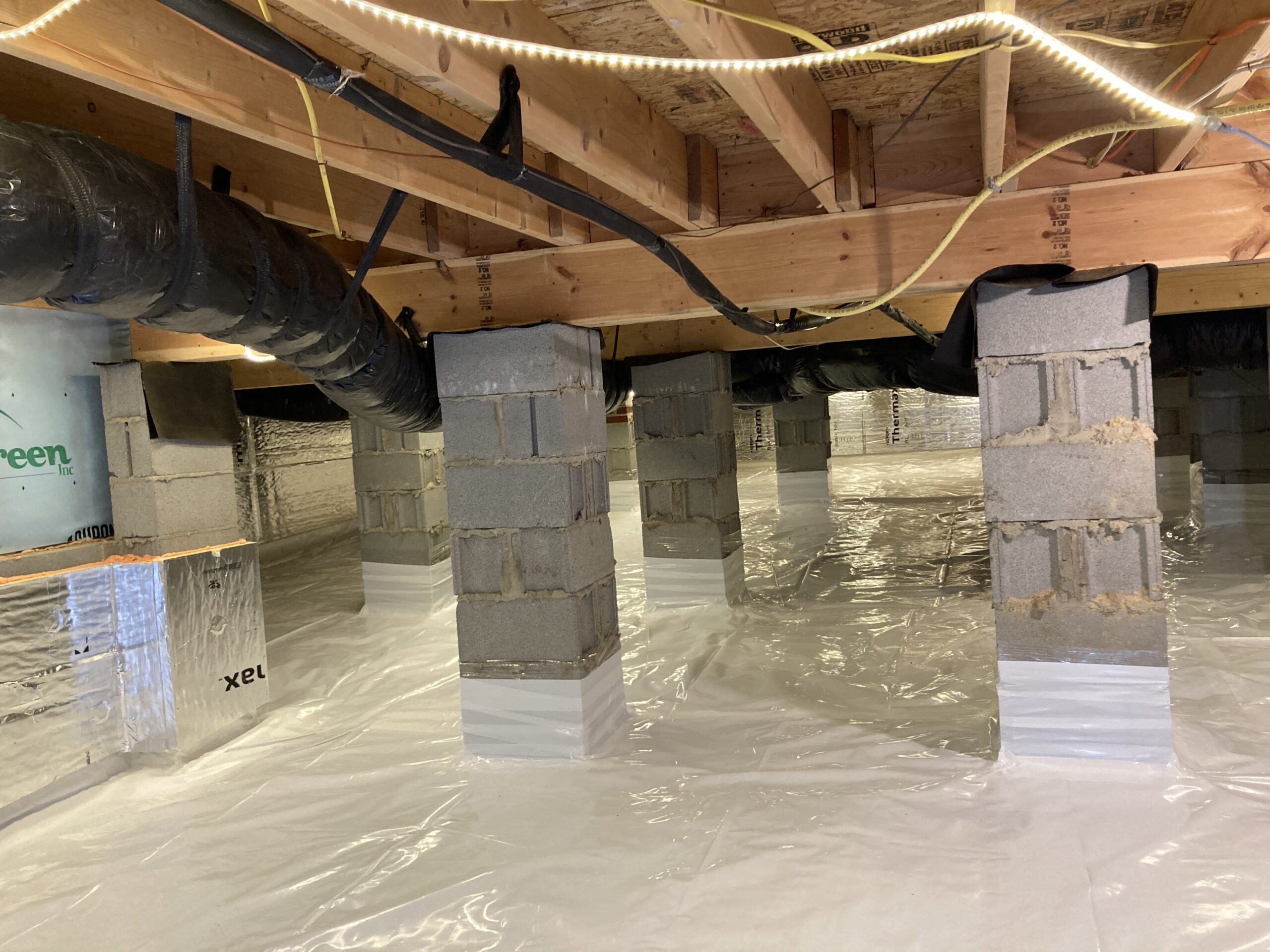
Additionally, much of north Raleigh’s housing stock — from the established neighborhoods of North Hills and Stonehenge to the newer developments along Durant Road, Strickland Road, and Six Forks Road north of 540 — sits on crawl space foundations. Crawl spaces are among the highest-risk foundation types for radon entry, because they provide direct soil exposure and often have multiple unsealed penetrations through the subfloor that allow radon-containing air to rise into the living area above.
“Radon doesn’t care how new your home is, how well-maintained it is, or how expensive it was. It moves through soil, enters through foundation gaps, and accumulates — invisibly — until something measures it.”
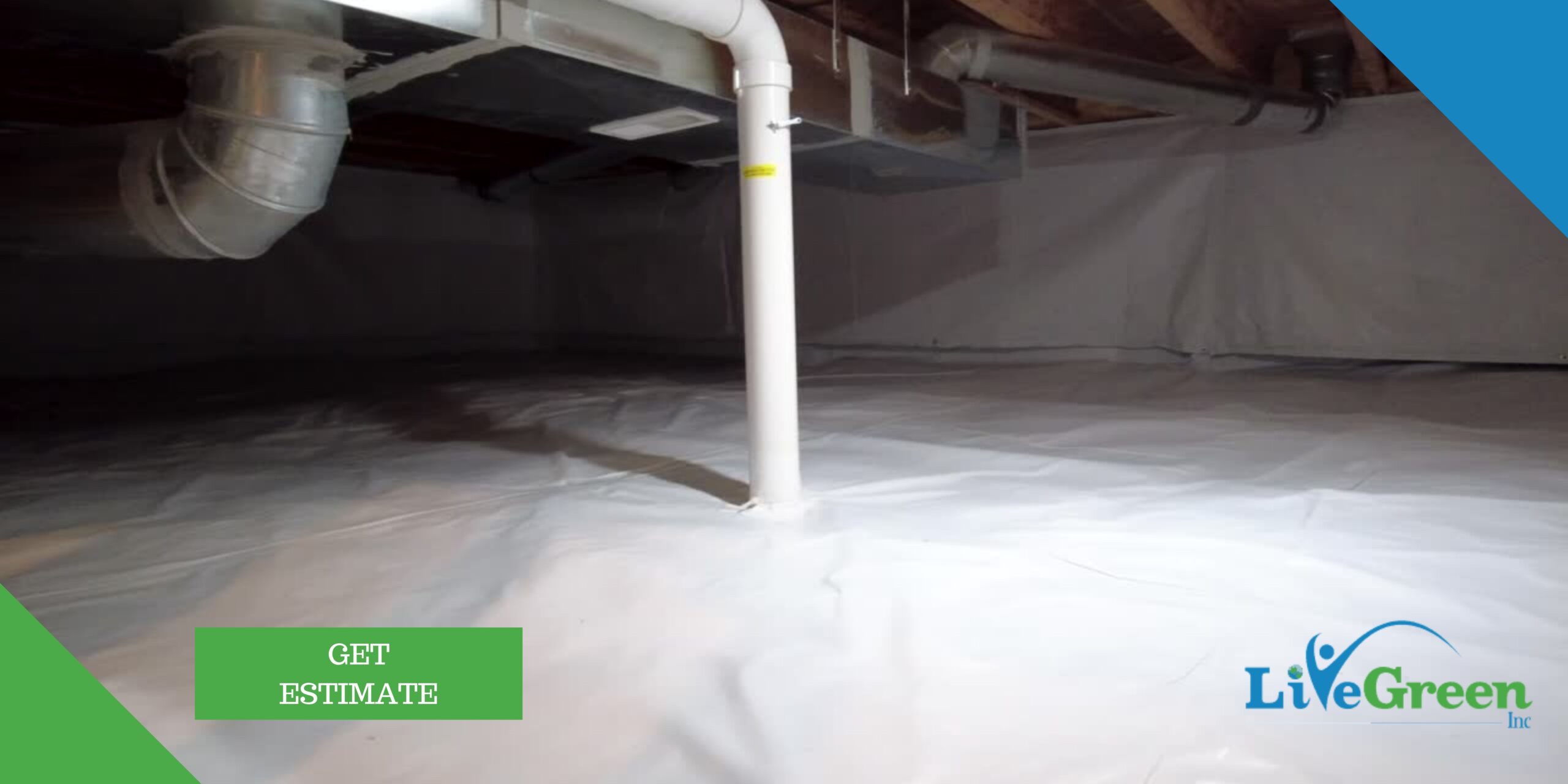
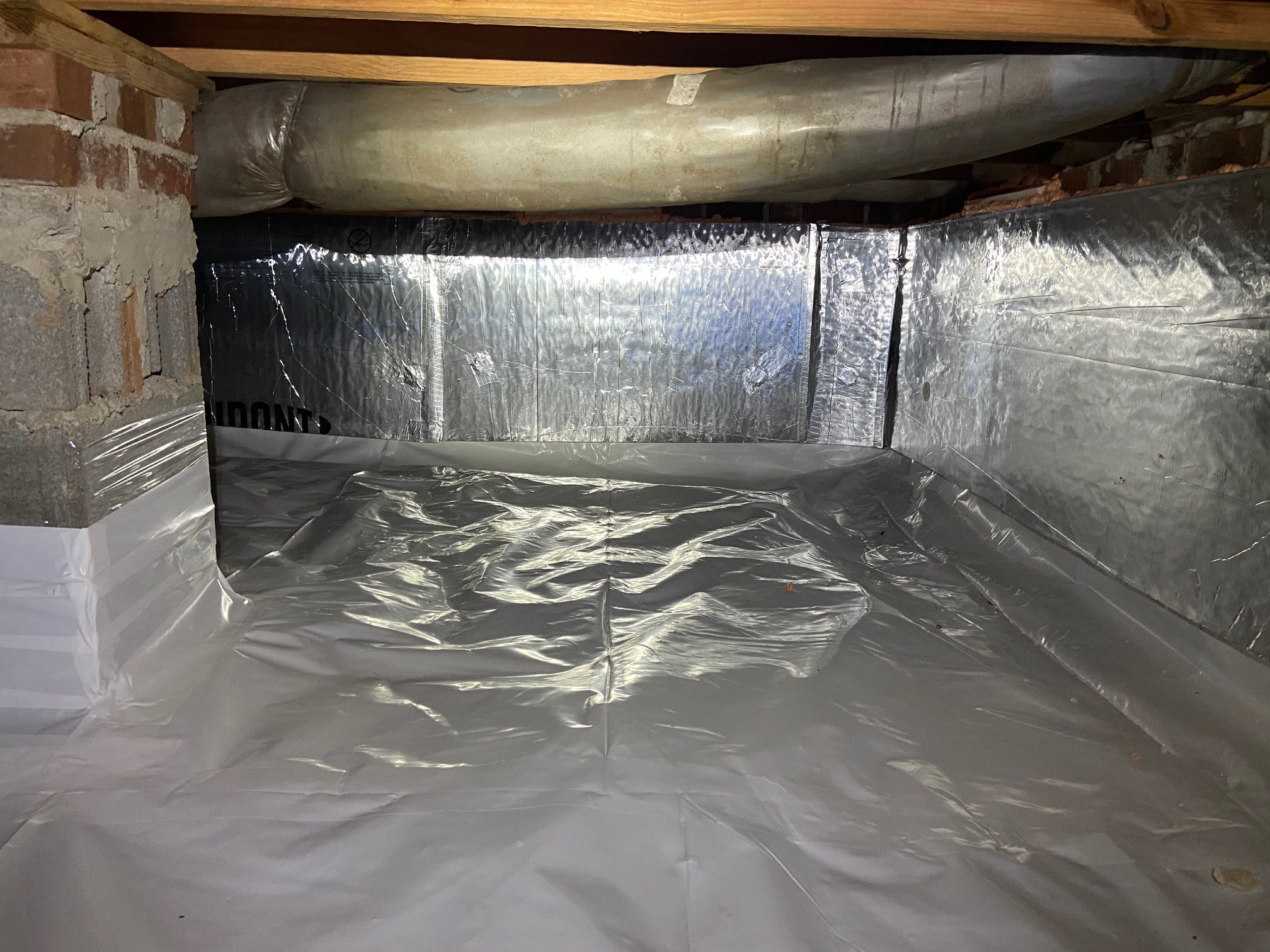
A sealed crawl space eliminates the primary pathway radon uses to enter a home — direct soil contact through an open foundation floor.
Understanding Radon Levels: What the Numbers Mean
Radon is measured in picocuries per liter (pCi/L) — a unit of radioactive concentration in air. The EPA has established guidelines for action based on measured levels. Here’s how to interpret your results:
It’s worth noting that the EPA’s action level of 4 pCi/L is not a “safe” threshold — it’s a practical one. The agency acknowledges that no level of radon exposure is completely risk-free; the goal of mitigation is to reduce levels as low as reasonably achievable. Many mitigation systems bring indoor levels below 2 pCi/L even when starting well above 4.
How Radon Gets Into Your Home — and Why Crawl Spaces Are the Highest Risk
Radon moves from the soil into homes through any available pathway. In homes on crawl space foundations — which describes a large percentage of north Raleigh’s housing stock — those pathways include:
Common Radon Entry Points in Crawl Space Homes
- Open crawl space floor — An unencapsulated crawl space with bare soil or a thin vapor barrier allows radon-containing soil gas to rise directly into the crawl space air, which then migrates upward into living areas.
- Foundation vent openings — Perimeter vents draw in outside air that carries radon from the surrounding soil, particularly on the downwind side of the home where pressure differentials pull soil gas inward.
- Gaps around pipes and wires — Plumbing, HVAC, and electrical penetrations through the subfloor create unsealed pathways for crawl space air — and the radon it carries — to enter living spaces.
- Cracks in foundation walls — Settling cracks in concrete block or brick foundations allow soil gas entry directly into the crawl space, particularly below grade where radon concentrations in soil are highest.
- HVAC return air leaks — Return air ducts that run through crawl spaces can draw in crawl space air — and radon — directly into the HVAC distribution system if they have gaps or unsealed joints.
The driving force behind radon entry is pressure differential. The interior of a home is typically at slightly lower pressure than the soil outside — caused by stack effect, HVAC operation, and exhaust fans. That pressure difference pulls soil gas inward through every available opening. In a vented, open crawl space, there are many.
Testing: The Only Way to Know
Radon cannot be seen, smelled, or otherwise detected without measurement. There is no way to estimate a home’s radon level from its location, age, construction type, or neighborhood — levels vary too much between individual properties. The only actionable answer comes from a test.
LiveGreen provides professional radon testing throughout north Raleigh and the Wake Forest Road corridor. Professional testing is more reliable than DIY mail-in kits for several reasons: proper device placement, controlled testing conditions, and results interpreted by someone who can explain what they mean and what to do about them. For homeowners buying or selling a home, professional results are also more credible to the other party.
Schedule a Test
LiveGreen places a professional-grade radon monitor in the lowest livable area of your home — typically the first floor above the crawl space — for a minimum 48-hour measurement period.
Receive Your Results
You receive a clear report of your home’s radon level in pCi/L with interpretation of what it means relative to EPA guidelines.
Assess Your Risk
We walk you through what the results mean for your home specifically — taking into account your foundation type, crawl space condition, and any existing vapor barriers.
Mitigate If Needed
If levels are at or above 4 pCi/L, we design a mitigation system for your home — typically combined with crawl space encapsulation for maximum long-term protection.
How Crawl Space Encapsulation and Radon Mitigation Work Together
Crawl space encapsulation and radon mitigation are not the same thing — but they are deeply complementary, and combining them in a single project is both more effective and more cost-efficient than doing them separately.
A sealed crawl space addresses radon’s primary entry pathway: the direct soil contact that allows radon-containing soil gas to rise into the crawl space air. By covering the entire floor and sealing the foundation walls with a heavy-duty vapor barrier, encapsulation dramatically reduces the volume of soil gas that enters the crawl space in the first place.
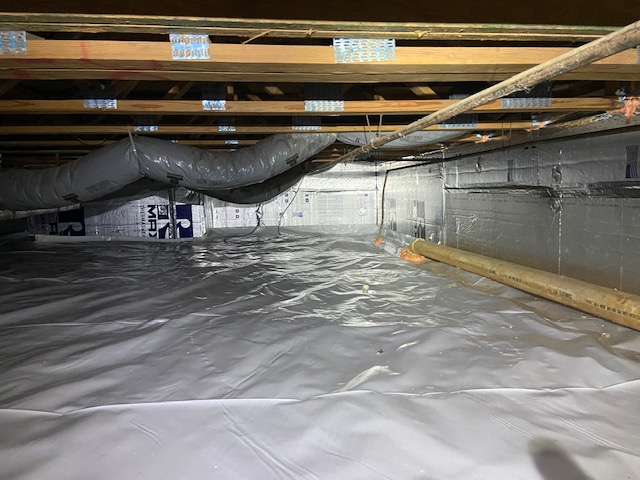
For homes where radon levels are at or above the EPA action threshold, a sub-membrane depressurization system is installed alongside the encapsulation. A suction point is created beneath the vapor barrier liner, and a dedicated fan draws radon-containing soil gas out from under the liner and exhausts it outside the home before it can enter the living area. This system continuously prevents radon accumulation as long as it operates — typically reducing levels by 50–99%.
Benefits of Combining Encapsulation + Radon Mitigation
- Single mobilization cost — Doing both in one project eliminates the overhead of scheduling and coordinating two separate contractors at two separate times.
- Better system integration — The radon mitigation suction point is designed into the encapsulation liner from the start, creating a cleaner and more effective installation than retrofitting mitigation into a previously encapsulated space.
- Comprehensive protection — The combined system addresses moisture damage, mold, indoor air quality, energy efficiency, and radon — all of the primary below-grade threats to your home and your health.
- Stronger resale documentation — A home with professional encapsulation and documented radon mitigation below the action level is a significantly stronger listing in north Raleigh’s competitive market.
- Peace of mind — One project, one professional, one warranty — and a crawl space you never have to worry about again.
When to Test: Key Moments for North Raleigh Homeowners
The EPA recommends testing every home — and retesting every two years, or after any significant renovation or change in ventilation. There are several specific situations where testing is particularly important for homeowners in north Raleigh and the Wake Forest Road corridor:
Buying a home: If the listing doesn’t include recent radon test results, request testing as part of your due diligence. Radon mitigation is a reasonable seller concession to request if levels are elevated — and it’s a much better conversation to have before closing than after.
After a renovation: Major renovations — particularly those involving the crawl space, HVAC system, or significant changes to the home’s envelope — can alter radon entry patterns. Retest after any substantial work.
If you’ve never tested: A significant percentage of Wake County homeowners have never had their home tested. If you’ve lived in your north Raleigh home for years without a radon test, you have no baseline — and you may be living with elevated levels without knowing it.
Seasonal testing: Radon levels tend to be higher in winter when homes are closed up and ventilation is reduced. Testing in fall or winter gives you a more conservative — and more protective — picture of your home’s actual exposure conditions.
Schedule Your Radon Test for Your North Raleigh Home
LiveGreen Inc provides professional radon testing and mitigation throughout north Raleigh, the Wake Forest Road corridor, and surrounding communities. Know your number — then act on it.
Schedule a Radon Test →Questions about radon testing or mitigation? Call us directly — we’re happy to answer your questions before you schedule anything.
(919) 453-6411Frequently Asked Questions
Answers to common questions about radon from north Raleigh and Wake Forest Road homeowners
It’s a common misconception that radon is only a concern in the Midwest or mountain states. While those regions do have higher average levels, the EPA consistently finds elevated radon in homes across all 50 states — including North Carolina. Wake County sits in the Piedmont, which has geological formations associated with radon production, and individual homes throughout north Raleigh and the Wake Forest Road corridor have tested above the EPA action level. The only way to know whether your home is one of them is to test. Assuming you’re safe because of your general location is exactly the mistake that leads to years of undetected exposure.
Unfortunately, no — and this is one of the most important things to understand about radon. Levels can vary dramatically between homes on the same street, even with identical construction. The specific geology beneath an individual lot, the condition of that home’s foundation, the number and size of unsealed penetrations, and local airflow patterns all influence how much radon enters a given home. A neighbor’s low reading tells you nothing reliable about your own. The only accurate answer for your home is a test in your home.
Both can produce valid results when used correctly, but professional testing offers meaningful advantages. Professional monitors are calibrated instruments rather than passive charcoal canisters, and they provide continuous readings rather than a single time-averaged snapshot. Proper placement is critical — the device must be in the lowest livable area, away from drafts and exterior walls, and the home must be in “closed-house conditions” during the test. Professional testing ensures all of these conditions are met, and results come with interpretation from someone qualified to explain what they mean and recommend next steps. For real estate transactions, professional results also carry more weight with buyers and their agents.
A thin builder-installed vapor barrier provides minimal radon protection. The standard poly sheeting installed during construction reduces direct soil contact but doesn’t seal the crawl space from radon-containing soil gas — radon still enters through the foundation vents, unsealed penetrations, and gaps around the barrier edges. A full encapsulation system with a heavy-duty sealed liner is significantly more effective at reducing radon entry. And for homes where levels are above the action threshold, a sub-membrane depressurization system installed beneath the encapsulation liner is the definitive solution — actively drawing radon out from under the barrier before it can enter the crawl space air.
A radon mitigation system installation is typically completed in one day. When combined with crawl space encapsulation, the combined project is usually two days. The work is done entirely in your crawl space and on the exterior of your home (where the exhaust pipe exits) — no interior living space is disrupted. The mitigation fan runs continuously but is quiet and draws minimal electricity. Most homeowners barely notice it’s there after installation. We provide documentation of the completed system, post-mitigation test results, and warranty information at project completion.
Yes — and ideally before you’re under contract. Testing proactively gives you time to address elevated levels before they become a negotiating issue with a buyer. A home that already has documented radon mitigation below the action level is a stronger listing than one where the buyer discovers elevated radon during their inspection period and requests remediation as a condition of closing. In north Raleigh’s market, where buyers are paying premium prices, having a clean radon history is a genuine differentiator. LiveGreen can typically schedule testing quickly and complete any needed mitigation within a week or two of results.
Radon mitigation systems are largely maintenance-free. The primary component — a continuously operating fan — typically has a lifespan of 5–10 years and can be replaced straightforwardly when needed. We recommend a visual check of the system annually (confirming the fan is operating, the indicator gauge shows proper suction) and a radon retest every two years to confirm levels remain below the action threshold. LiveGreen provides clear documentation of your system at installation so you know exactly what to check and when.
What Raleigh Homeowners Are Saying
