

Spray-applied acoustical and thermal finishes for exposed decks, ceilings and structure — noise control that follows the shape of the building instead of hiding it behind a dropped ceiling.
Commercial acoustical spray is a cellulose- or fiber-based insulation applied wet with a water-based adhesive directly onto an exposed ceiling deck, joist or wall. It dries to a monolithic textured finish that absorbs sound instead of bouncing it, and it is usually left exposed as the finished surface.
It exists because modern commercial interiors are made of hard, reflective things. A school commons, a brewery taproom, a fitness studio or an open-plan office with an exposed metal deck, sealed concrete and glass has nothing in it to absorb sound. Speech bounces, reverberation time climbs, and the room becomes exhausting to be in — the complaint usually arrives as "you can't hear anyone in here," not as a number.
Spray-applied acoustical treatment fixes that without a dropped ceiling, and it does something panels and clouds cannot: it follows complicated geometry. Deck flutes, bar joists, ductwork, sloped roofs and curved surfaces all get the same continuous coverage in one pass.
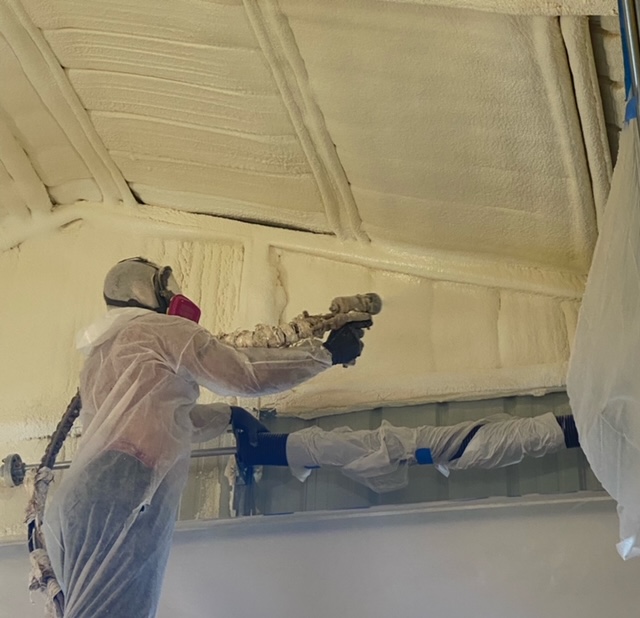
Live Green spray crews working overhead on an exposed commercial deck.
Acoustical performance is measured as a Noise Reduction Coefficient (NRC) — roughly, the fraction of sound energy the surface absorbs instead of reflecting. NRC 0 is a mirror; NRC 1.00 absorbs essentially everything striking it. Thickness is the main lever, and it is the number that should be specified.
| Property | Typical performance |
|---|---|
| NRC at 1/2 inch on solid backing | Around 0.65 — enough for a corridor, a lobby or a moderately live meeting room. |
| NRC at 1 inch | Around 0.90 — the common specification for gyms, cafeterias, taprooms and open offices. |
| NRC at higher thicknesses | Up to about 1.05 in the heavier cellulose products, used where reverberation control is the whole point. |
| Thermal resistance | Roughly R-3.7 per inch, so the same pass that fixes the acoustics adds real insulation value. |
| Fire performance | Class 1 / Class A surface burning characteristics with a very low flame spread index. |
| Test method | NRC established by the room reverberation method under ASTM C423. |
| Recycled content | Cellulose products are typically made largely from pre-consumer recycled fiber, which can support green building credits. |
Figures above are typical for cellulose spray-applied acoustical products. Exact values come from the specific product and thickness used on your project, and we will put the manufacturer's test data in the submittal.
Acoustical panels and clouds are the right answer in plenty of rooms — a rectangular conference room with a flat ceiling, for instance. Spray wins in three situations, and they come up constantly in Triangle-area construction.
When the ceiling is not flat. Exposed bar joists, deck flutes, sloped roofs and a full run of mechanical overhead make panel layout a nightmare and leave hard reflective surfaces between every panel. Spray coats all of it.
When the exposed structure is the design. A brewery, a gym, an adaptive-reuse office in a warehouse shell — the client wants to see the structure, not a grid ceiling. Sprayed finish keeps the look and fixes the noise.
When you need thermal value too. On an exposed roof deck, one sprayed application delivers both the acoustic absorption and the insulation. Panels do not insulate the deck.
Any room where hard surfaces and human voices meet.
Spray goes on after overhead MEP is roughed in and before finishes, so we are coating the deck rather than working around finished work. Overspray protection is part of the scope.
The deck has to be clean and sound for adhesion. Galvanized deck, painted deck and previously coated surfaces each behave differently, so we look before we price.
Standard finishes come in a range of colors and textures. Match to the design intent early — recoating a whole deck to change color is not a small change order.
NRC scales with thickness. A spec that says "acoustical spray" without a thickness or a target NRC will get bid three different ways by three contractors.
Product data, ASTM C423 acoustical test reports, surface burning characteristics and color samples, packaged for architect review.
If the same deck also needs insulation, an air barrier or a thermal barrier over foam, we can carry all of it on one contract instead of coordinating three subs over the same square footage.
Our crews spray commercial buildings statewide. Acoustical project photos are being added as jobs complete.

Live Green Inc.
5001 Old Poole Road
Raleigh, NC 27610
Phone: (919) 453-6411
Fax: (919) 803-2001
Office hours: Monday–Friday 7 AM–5 PM
We bid acoustical spray work statewide — Raleigh, Durham, Chapel Hill, Cary, Wake Forest, Greensboro, Charlotte, Fayetteville and Wilmington.
It is a cellulose or fiber insulation applied wet with a water-based adhesive directly onto a ceiling deck, joist or wall, where it dries into a continuous textured finish. It absorbs sound rather than reflecting it, and it is normally left exposed as the finished surface rather than covered by a ceiling.
Roughly 0.65 at half an inch on a solid backing, roughly 0.90 at one inch, and up to about 1.05 in the heavier products at greater thickness. Because performance scales with thickness, a specification should state a target NRC or a thickness rather than just naming the material.
Yes. Cellulose spray products deliver roughly R-3.7 per inch, so on an exposed roof deck a single application handles both the sound absorption and the thermal performance. That dual duty is a large part of why it gets specified on exposed structure.
These products carry Class 1 or Class A surface burning characteristics with a very low flame spread index, which is what allows them to be left exposed in occupied commercial space. That is a surface burning rating, not a fire-resistance rating, so it does not replace fireproofing on structural steel.
Often yes, provided the substrate is clean, sound and compatible with the adhesive. Painted or previously coated decks need to be assessed first, because adhesion is the whole job. We look at the actual surface before pricing a renovation.
Standard product lines offer a range of colors and textures, from white and off-white through greys and darker tones for a blacked-out exposed ceiling look. Choose the color during design, because recoating an entire deck later is a significant cost.
Send the drawings, the ceiling plan and the target NRC if an acoustical consultant has set one. We will price the spray and, if the same deck needs it, the insulation with it.
Live Green Inc. · 5001 Old Poole Road, Raleigh, NC 27610 · Monday–Friday 7 AM–5 PM
