

LiveGreen Named a Top Crawl Space Encapsulation Service for 2026
Live Green Inc. · Raleigh, North Carolina
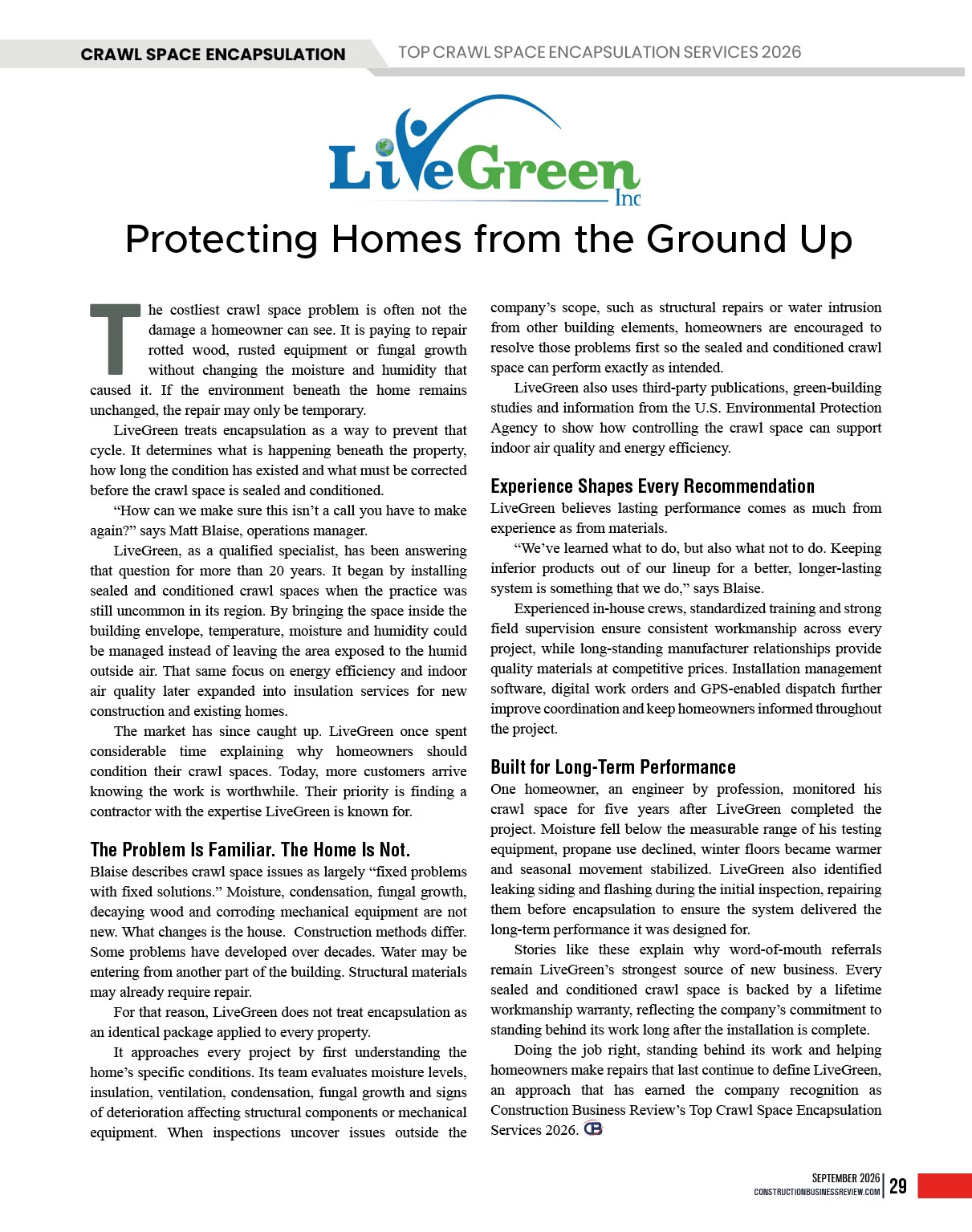
Construction Business Review has named LiveGreen to its Top Crawl Space Encapsulation Services list for 2026, and ran a profile of the company alongside it. What we found more useful than the recognition itself was the editorial that ran opposite it — a plain-spoken piece on how a homeowner should actually judge a crawl space contractor. That list of criteria is worth reading whether or not you ever call us.
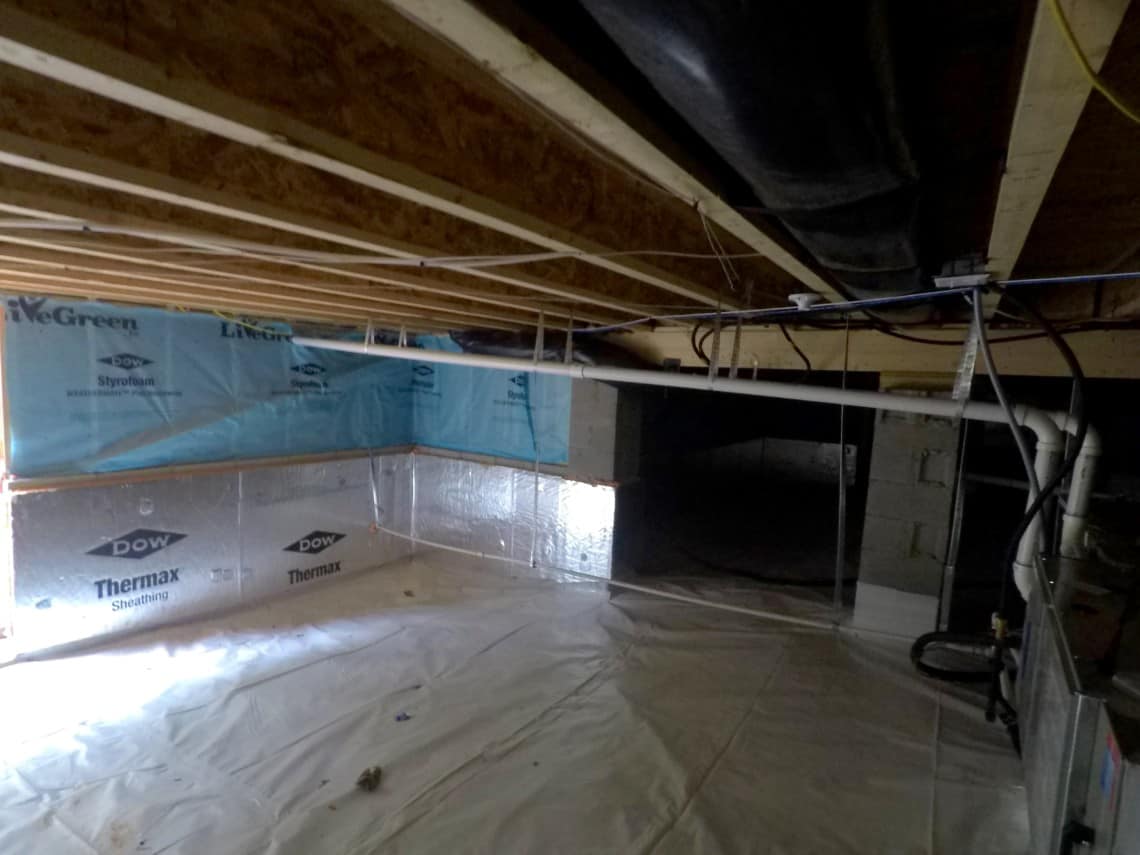
A finished sealed and conditioned crawl space on a North Carolina home — liner across the floor, insulation board at the perimeter, foundation vents closed.
Protecting Homes from the Ground Up
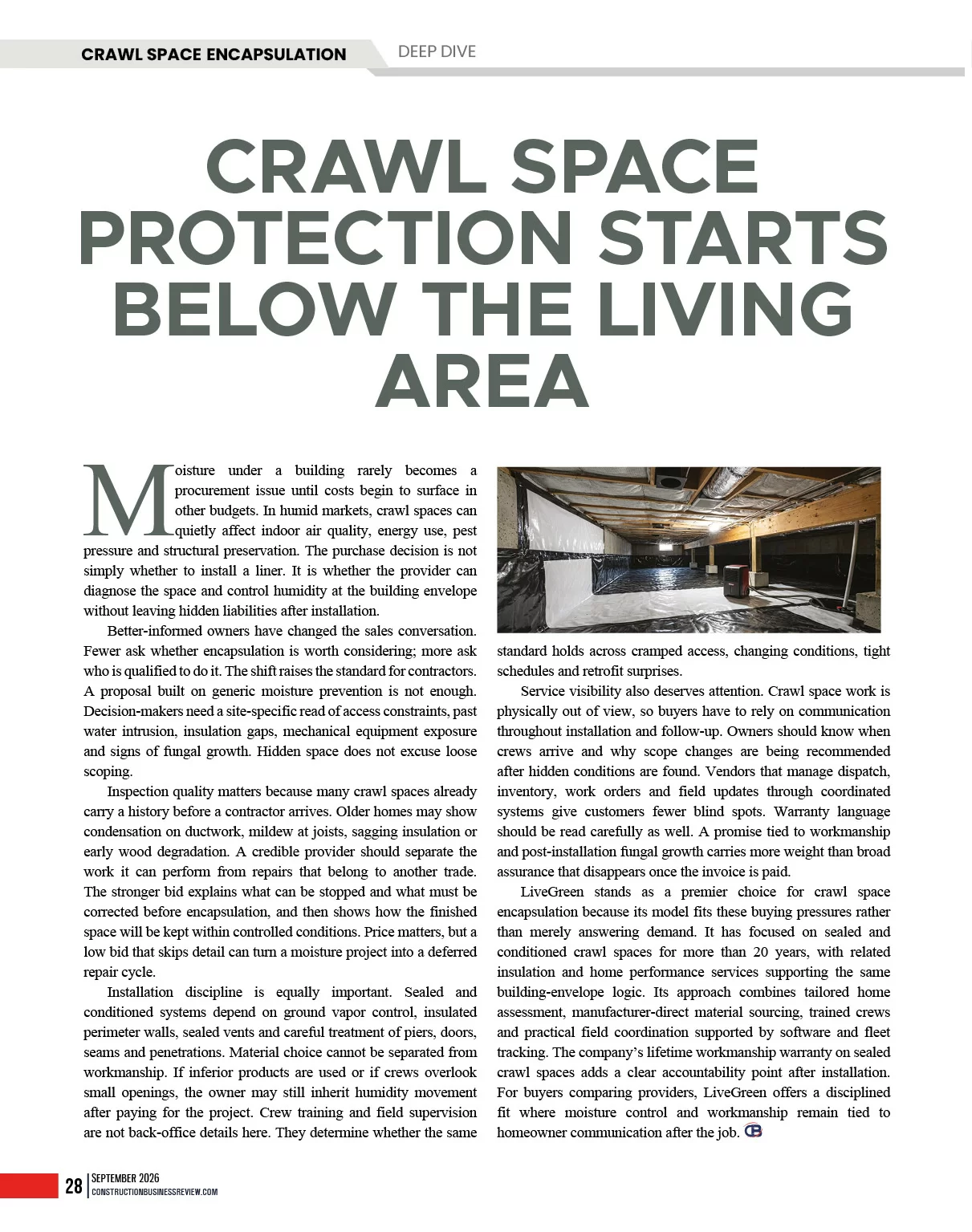
Running alongside it on page 28: Crawl Space Protection Starts Below the Living Area, the magazine’s own guidance on how to judge a crawl space contractor — summarised further down this page.
Read the September 2026 issueOpens the full digital issue at the cover. Both pages are reproduced below if you would rather read them here.
The question behind the whole thing
The profile opens on a question our operations manager asks on site visits, and it is the one that decides whether an encapsulation was worth paying for.
“How can we make sure this isn’t a call you have to make again?”
Matt Blaise, Operations Manager · Construction Business Review, September 2026
It sounds like a customer-service line. It is actually a scoping rule. The most expensive crawl space problem is rarely the damage you can see — it is paying to replace rotted framing, corroded ductwork or a failed subfloor without changing the moisture that produced it. Fix the wood, leave the humidity, and you have bought yourself a repeat of the same repair on a slower clock.
What the magazine says to look for in a contractor
The editorial on page 28 lays out what separates a real encapsulation proposal from a cheap one. We are summarising it in our own words here; the full piece is worth ten minutes of your time before you sign anything.
- A site-specific diagnosis, not generic moisture prevention The bid should show that somebody actually went under the house: access constraints, evidence of past water intrusion, gaps in the existing insulation, how exposed the mechanical equipment is, and any signs of fungal growth. A proposal that would read identically on any house was written for any house.
- A clear line between their work and someone else’s A credible contractor separates what they can do from repairs that belong to another trade, and says which problems must be corrected before encapsulation rather than sealed over. Structural repair and active water intrusion from elsewhere in the building are the usual examples.
- Installation detail, because that is where systems fail Ground vapor control, insulated perimeter walls, sealed vents, and deliberate treatment of piers, doors, seams and penetrations. Miss a few small openings and the homeowner still inherits humidity movement after paying for the project.
- Materials and workmanship judged together The two cannot be separated. Good product installed carelessly and cheap product installed well fail in different ways, but they both fail. That is a question about crew training and field supervision, not a back-office detail.
- Visibility into work you cannot watch Crawl space work happens out of sight, so communication is the only window you get. You should know when crews are arriving and why a scope change is being recommended when hidden conditions turn up mid-job.
- Warranty language you can actually read The magazine is blunt about this one: a warranty tied specifically to workmanship and to post-installation fungal growth carries far more weight than a broad assurance that evaporates once the invoice is paid. Read the document, not the brochure.
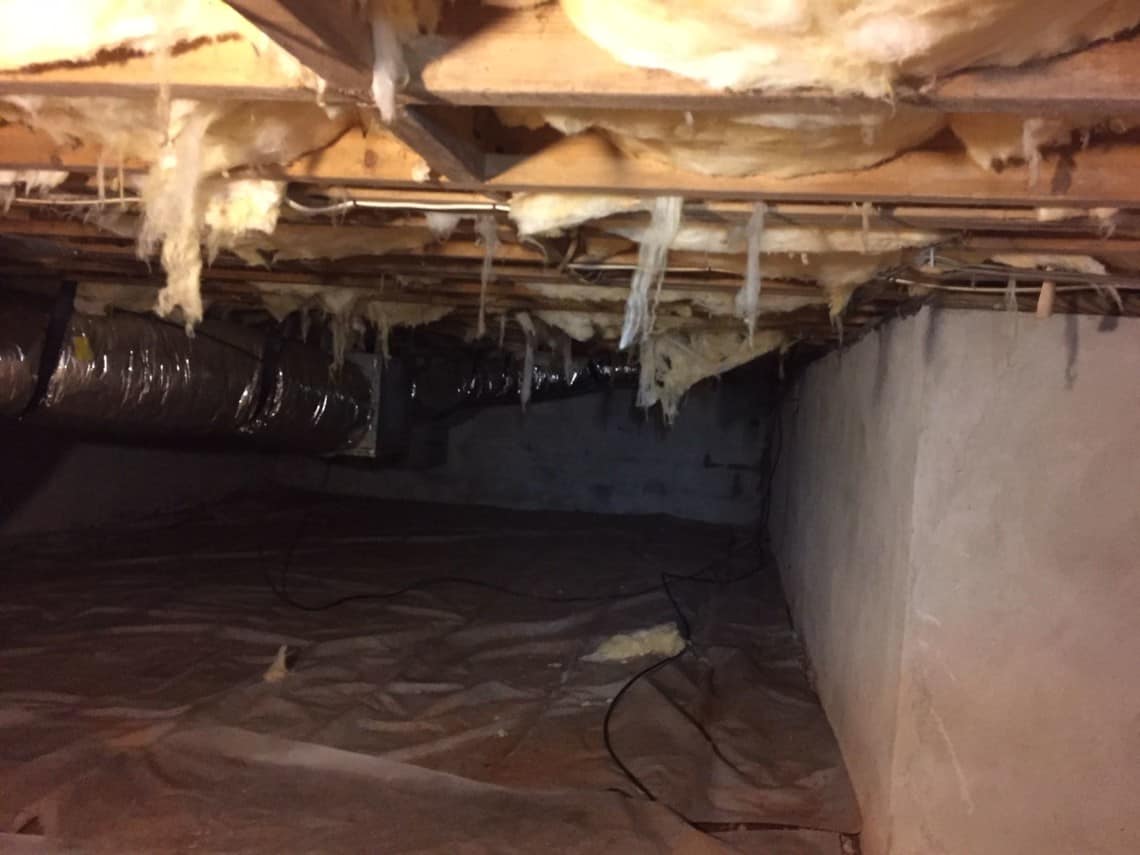
The condition the criteria above are meant to prevent: batt insulation dropping out of the joists, ductwork running through humid air, bare soil underneath. None of this happened quickly.
Where we land against that list
We did not write the criteria, which is the useful part. Here is what the profile reports about how LiveGreen works, measured against them.
- Twenty-plus years on this specific problem. LiveGreen has focused on sealed and conditioned crawl spaces since 2003, with insulation and home performance work built on the same building-envelope logic.
- Assessment first, package second. Every project starts with a read of that house — moisture levels, insulation, ventilation, condensation, fungal growth, and the condition of structural and mechanical components.
- Scope honesty. When an inspection turns up something outside our scope, such as structural repair or water entering from another part of the building, we ask homeowners to resolve that first so the sealed crawl space can perform as designed.
- In-house crews, standardised training, field supervision. Consistency across jobs is a staffing decision more than a materials decision.
- Manufacturer-direct sourcing, and products we have chosen to stop using. Long-standing manufacturer relationships keep quality materials at competitive prices — and, as Matt puts it in the profile, keeping inferior products out of the lineup is itself part of the system.
- Coordination people can see. Installation management software, digital work orders and GPS-enabled dispatch keep homeowners informed instead of guessing.
- A lifetime workmanship warranty on every sealed and conditioned crawl space we install.
- ABAA-certified and an SPFA member, working residential and commercial projects across North Carolina.
The five-year version of “did it work?”
The profile includes an account we like because the homeowner did the measuring, not us. He is an engineer, and he monitored his crawl space for five years after we finished. Moisture fell below the measurable range of his own testing equipment. Propane use went down. Winter floors were warmer, and the seasonal movement in the house settled.
The detail that matters most, though, came before any of that: during the initial inspection we found leaking siding and flashing and repaired them first. Encapsulating over an active leak would have produced a sealed crawl space with water still arriving. That sequence is the difference between a system that performs for five years and one that photographs well on handover day.
Why this argument lands hardest in North Carolina
The magazine writes for a national construction audience, but the Piedmont is close to a worst case. Summer air here carries a dew point in the low 70s, and our clay soil holds water and gives it back slowly. Push that humid air through foundation vents and into a cooler crawl space and it condenses on the coldest surfaces it finds — ductwork, joists, the subfloor.
Which means the vents that were supposed to dry the crawl space out are a large part of why it is wet. That is not homeowner neglect. It is a building convention borrowed from a drier climate and applied where it does not fit. We made the same case in Matt’s earlier article for the magazine, and it is the reasoning behind every sealed crawl space we install.
Word-of-mouth referrals are still where most of our work comes from, which is the recognition we would keep if we had to choose. But we will take this one too.
The printed feature
Both pages as they ran in the September 2026 issue. Click either one to open it full size.

Matt Blaise
Operations Manager, Live Green Inc.
Matt runs day-to-day operations at Live Green, the Raleigh-based contractor that has been sealing and conditioning crawl spaces across North Carolina since 2003. The company is ABAA-certified and an SPFA member, and works on residential and commercial projects statewide.
Want the assessment the article describes?
We go under the house, take real moisture readings, photograph what is down there, and tell you what your crawl space actually needs — including the parts that are not our work.
Get a Free EstimateOr call us directly at (919) 453-6411 · Monday–Friday 7 AM–5 PM
