

Nobody wants to read nine paragraphs before they get a number, so here it is first, with the honest caveat attached.
That is the range published for a typical North Carolina crawl space encapsulation in 2026, with the state average landing near $5,100. Larger, wetter or more complicated crawl spaces run higher — published guides put the top of the North Carolina range around $13,500 once drainage, structural repair or significant remediation is involved.
These are industry-published ranges, not our price list. Sources are listed at the bottom of this page. We price every job after actually going under the house, because the variables below move the number far more than square footage does.
Why a square-foot price tells you so little
Published per-square-foot figures for North Carolina run from about $2.76 to $7.36. That is not a rounding difference — the top of the range is well over twice the bottom. Two 1,400 square foot crawl spaces on the same street can land at opposite ends of it.
The reason is that encapsulation is not one product. It is a stack of decisions, and each one has a cheap version and a durable version. A quote is really a list of which versions you are buying.
| Crawl space size | Typical published 2026 range | What usually sits at the low end |
|---|---|---|
| Under 1,000 sq ft | $3,300 – $6,000 | Dry space, good access, liner and vent sealing only |
| 1,000 – 1,500 sq ft | $4,200 – $8,800 | Straightforward layout, no drainage work, no remediation |
| 1,500 – 2,000 sq ft | $6,000 – $11,000 | Adds wall insulation and humidity control |
| Complex or wet spaces | up to about $13,500 | Drainage or sump, debris and old insulation removal, remediation, tight access |
Use that table to sanity-check a quote, not to budget precisely. A quote that lands far below the range for your size is usually leaving something out, and the omission is rarely obvious from the paperwork.
The cheapest quote and the most expensive quote on the same house are usually not describing the same job. They are describing different jobs that share a name.
What actually moves the price
1. Bulk water, and whether it has been dealt with
This is the single biggest swing factor. If water enters the crawl space after heavy rain, that has to be solved before a liner goes anywhere — regrading, downspout extensions, interior drainage, sometimes a sump with a discharge line. Drainage work can add several thousand dollars on its own, and skipping it means installing a liner over a problem that will surface again.
2. Liner thickness and how it is terminated
Liner runs anywhere from thin sheeting to heavy reinforced membrane. Thickness matters, but termination matters more: whether the liner is merely laid on the floor or carried up the walls, sealed at the seams, and attached and sealed at the top. A floor-only liner is a fraction of the cost and a fraction of the performance.
3. Insulation, and where it goes
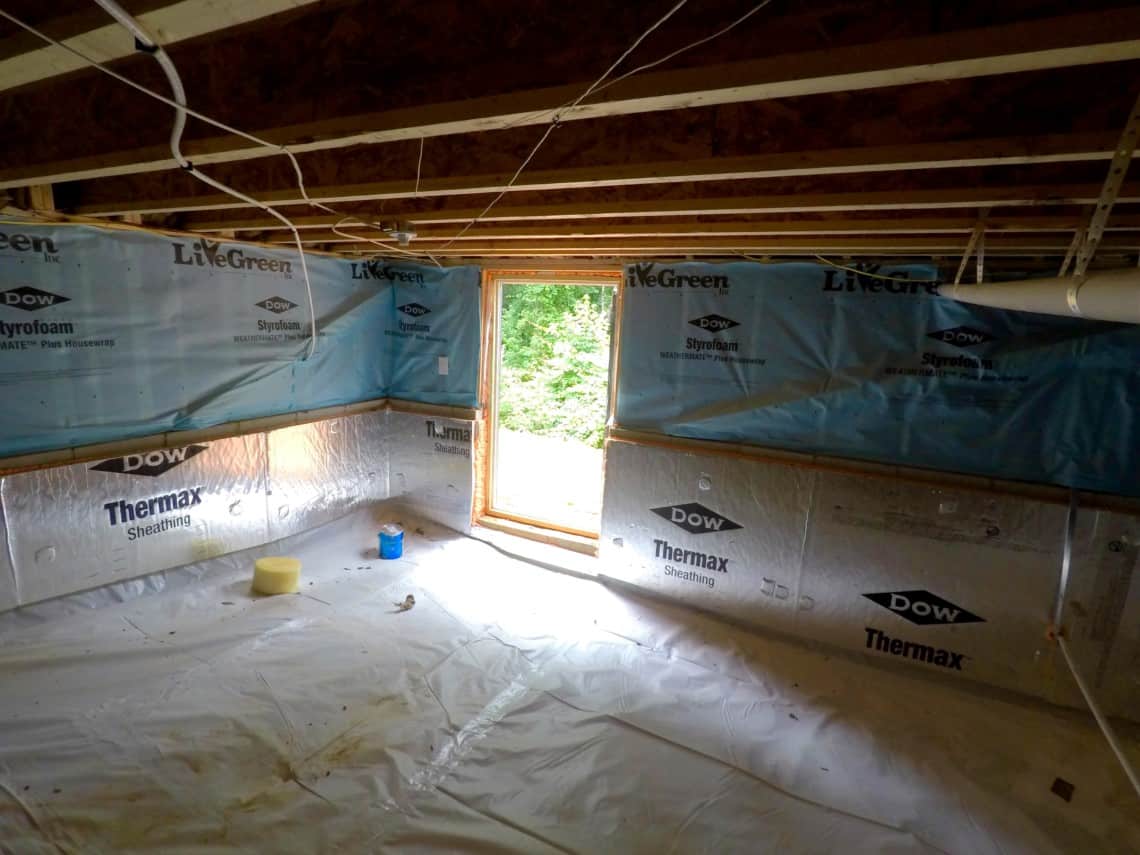
In a sealed crawl space the insulation generally belongs on the perimeter walls and rim joist rather than in the floor joists. That is more material and more labor than leaving old fiberglass in place, and it is one of the most common differences between a low and a high quote.
4. How the remaining humidity is managed
Some houses need a dehumidifier. Some are better served by supplying a small amount of conditioned air from the existing HVAC system. A dehumidifier is equipment cost plus an operating cost you pay every month afterward, so this decision has a long tail. It should be made on the house, not on habit.
5. What has to come out first
Wet fiberglass falling out of the joists, old torn plastic, construction debris, and in some houses years of accumulated junk all have to be removed by hand through a hatch. Remediation of existing mold growth is separate again. None of this is visible on a floor plan, which is why quotes given without an inspection are guesses.
6. Access
An 18-inch clearance crawl space with a single tight hatch takes materially longer to work in than one you can move through at a crouch. Labor is a large share of this job, so access shows up directly in the price.
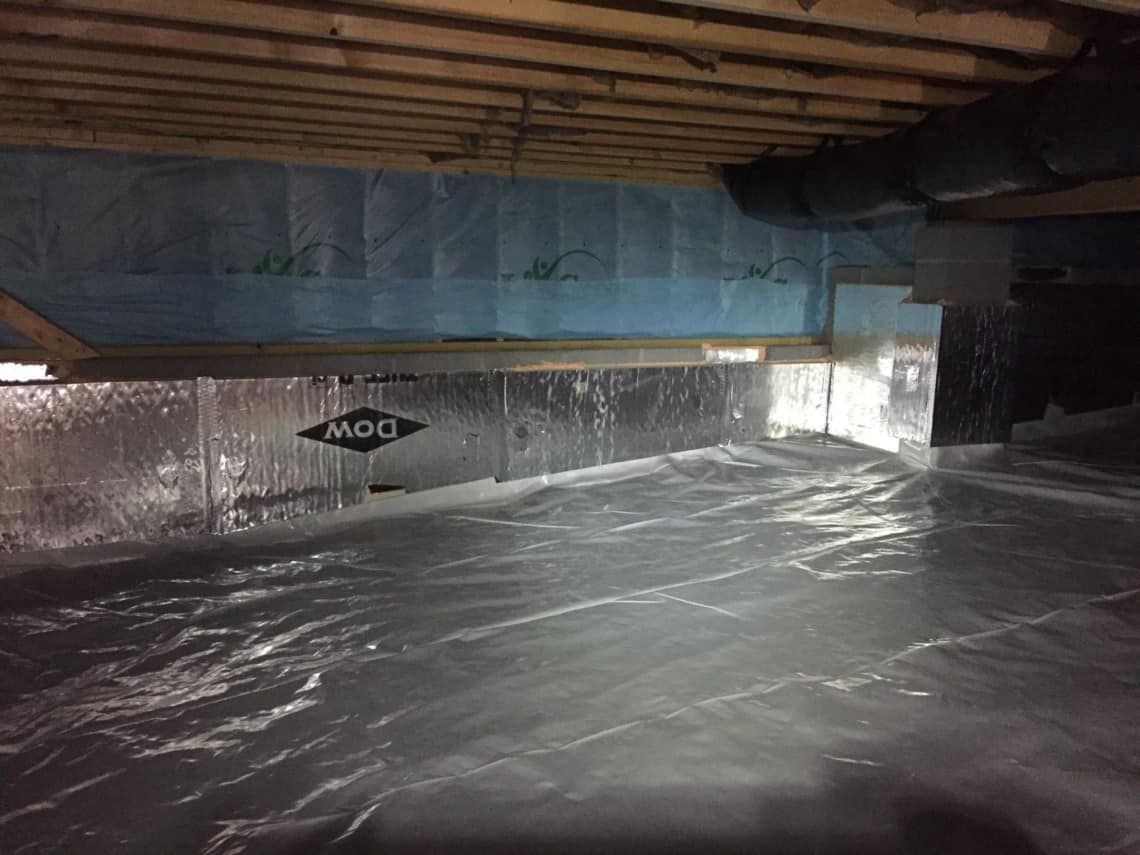
A finished sealed crawl space — liner across the floor and up the walls, rigid board on the perimeter, rim joist closed. The wall insulation and the sealed terminations are two of the line items that separate a mid-range quote from a cheap one.
What a cheap quote usually leaves out
A quote well under the published range for your size is not necessarily dishonest, but something is missing. In our experience the omissions are almost always the same short list: the liner stops at the floor instead of going up the walls, seams are overlapped rather than sealed, the piers and penetrations are not wrapped, existing wet insulation stays where it is, the vents are not properly sealed, and drainage is left for later. Ask for each of those in writing.
Is it worth the money?
Encapsulation is not primarily an energy-savings purchase, and any contractor who sells it that way is overpromising. Sealed crawl spaces do reduce heating and cooling load, and floors over them are noticeably warmer in winter, but the payback period on utility savings alone is long.
The honest value case is three other things. It removes a large, continuous moisture source from the house, which is what stops mold from coming back season after season. It protects the framing you are standing on, which is the expensive thing to repair. And a dry, documented, encapsulated crawl space is an asset at resale in a market where buyers' inspectors in this part of the state look specifically for crawl space moisture.
- Get the moisture readings before you get the price. Numbers first, solution second.
- Ask what is excluded, not just what is included. The exclusions are where quotes diverge.
- Get drainage priced separately so you can see it rather than have it buried or omitted.
- Ask whether a dehumidifier is required or merely being added, and what it costs to run.
- Ask what the warranty covers — materials, workmanship, or a humidity performance level.
Common questions about cost
How much does crawl space encapsulation cost in Raleigh?
Published 2026 ranges for North Carolina put a typical encapsulation between roughly $4,400 and $8,300, with the state average near $5,100. Complex jobs involving drainage, structural repair or significant remediation run higher, up to around $13,500. The final number depends far more on water, access and what has to be removed than on square footage alone.
Why are encapsulation quotes so different from each other?
Because the word covers several different scopes of work. One quote may include a floor liner and nothing else, while another includes wall terminations, sealed seams, wrapped piers, vent sealing, wall insulation, humidity control and drainage. Compare the line items rather than the totals, and ask each contractor what they have excluded.
Does encapsulation lower my power bill?
It usually reduces heating and cooling load, and floors above the crawl space get noticeably warmer in winter, but utility savings alone are a slow payback. The stronger reasons are removing a continuous moisture source from the house, protecting the floor framing from decay, and having a dry documented crawl space when you sell.
Is a dehumidifier included in the price?
Sometimes, and it is worth asking directly. A dehumidifier adds equipment cost up front and an operating cost every month afterward. In a properly sealed and insulated crawl space it is not always necessary, and some homes are better served by supplying a small amount of conditioned air from the existing system instead. Treat it as a design decision rather than a default inclusion.
Can I encapsulate part of my crawl space to save money?
Generally no, and partial work is one of the more common ways money gets wasted. The sealed space only performs as a sealed space if it is continuous; leaving a section open leaves the moisture path open with it. Where budget is tight, it is usually better to stage the work in a deliberate order, handling water and ground cover first, than to encapsulate half the footprint.
How long does the work take?
A straightforward crawl space is often a two to three day job. Spaces that need debris and old insulation removed, drainage installed, or remediation done before the liner goes in take longer. Access is a real factor, because everything has to be carried in and out through the hatch by hand.
Where these numbers come from
The ranges on this page are published third-party figures for North Carolina in 2026, not Live Green's price list. We have cited them so you can check them yourself.
- CrawlSpaceCosts.com — North Carolina cost data (2026)
- CrawlSpaceCosts.com — North Carolina cost guide (2026)
- Crawl Space Cost Calculator — North Carolina state pricing (2026)
For a number that applies to your house rather than to an average one, we have to look at it.
Get a real number for your crawl space
We go under the house, take moisture readings, photograph what is down there, and price the work that is actually needed. No charge for the assessment.
Get a Free EstimateOr call us directly at (919) 453-6411 · Monday–Friday 7 AM–5 PM
