

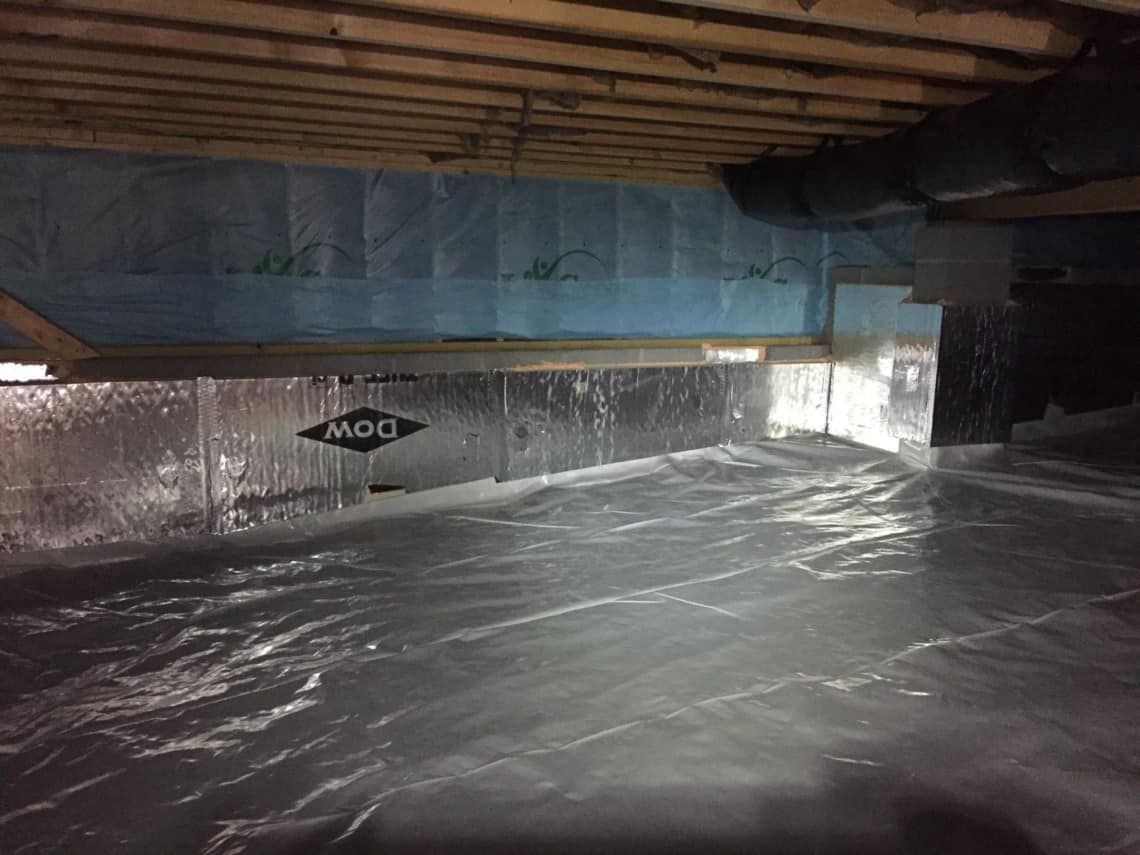
You did the responsible thing and got three quotes. One came back at about $4,000, one at $8,000, one at $12,000. Same house, same crawl space, same week. It is a genuinely confusing moment, and the natural conclusion — that somebody is trying to rip you off — is usually the wrong one.
Most of the time all three contractors are quoting honestly. They are just quoting different jobs that share the same name. "Encapsulation" is not a defined product with a fixed specification, so each company decides what belongs in it, and those decisions are where your $8,000 went.
Here is the line-by-line list of what actually changes between them, so you can lay three quotes side by side and compare the work instead of the totals.
Ask each contractor what they excluded. It is a more useful question than what they included, and it is the one that separates the three numbers.
The eight line items that move the number
1. Drainage and bulk water
If water enters the crawl space after heavy rain, it has to be handled before anything else — regrading, downspout extensions, interior perimeter drain, sometimes a sump pump and discharge line. This is the largest and most common difference between quotes, and it is frequently the reason a cheap quote is cheap: it simply does not include it.
A liner installed over an unresolved water problem traps water against the soil and hides the symptom rather than fixing it. If one quote includes drainage and another does not, you are not comparing like with like at all.
2. Where the liner stops
The cheapest version lays liner on the crawl space floor and stops there. A complete installation carries the liner up the foundation walls, mechanically attaches it, and seals the top termination so moisture cannot bypass it. The material difference is modest; the labor difference is significant, and so is the performance difference.
3. Seams, piers and penetrations
Overlapping two sheets of liner is not the same as sealing them. Neither is running the liner around a support pier versus wrapping and sealing to it. Plumbing penetrations, duct supports and the crawl space access all have to be detailed individually. This is slow, unglamorous work, it is invisible once complete, and it is quietly one of the largest labor differences between two quotes.
4. Liner specification
Liner ranges from thin sheeting up to heavy reinforced membrane. Thicker material costs more, resists puncture from anyone who has to work down there later, and lasts longer. This matters, but it is worth knowing that liner thickness is a smaller share of the price difference than the termination and seam work above — it is simply easier to put in a sales pitch.
5. Insulation, and where it goes
Some quotes leave the existing fiberglass in the floor joists. Some remove it. Some remove it and insulate the perimeter walls and rim joist instead, which is the approach that matches a sealed crawl space. That last version is materially more expensive and is the correct answer for most sealed spaces, because the crawl space is now inside the building envelope rather than outside it.
6. Humidity control
A dehumidifier is real equipment cost plus an operating cost you pay every month for as long as you own the house. Supplying a small amount of conditioned air from the existing HVAC system is a different approach with a different cost profile. Some quotes include a dehumidifier by default, some price it as an option, and some leave it out entirely. Ask which, and ask why that choice suits your house.
7. What has to be removed first
Wet fiberglass hanging out of the joists, old torn plastic, construction debris and accumulated junk all have to come out by hand through the hatch before work starts. Existing mold growth is a separate remediation scope again. A quote given without anyone going under the house cannot possibly have priced this correctly.
8. Warranty, and what it actually covers
A materials warranty covers the liner failing. A workmanship warranty covers the installation. A performance warranty commits to a humidity level in the space and is the only one that promises the thing you are actually buying. They are very different promises and they are frequently presented with equal confidence.
What the three quotes usually contain
The table below is an illustrative comparison of how scope typically stacks up across three price tiers on a mid-sized Triangle crawl space. These are scope tiers, not Live Green price points — they are anchored to the published North Carolina ranges on our cost guide.
| Line item | The low quote | The middle quote | The high quote |
|---|---|---|---|
| Liner on floor | Yes | Yes | Yes |
| Liner up walls, sealed termination | No | Yes | Yes |
| Seams sealed, piers wrapped | Overlapped only | Yes | Yes |
| Vents sealed | Sometimes | Yes | Yes |
| Old wet insulation removed | No | Yes | Yes |
| Perimeter wall insulation | No | Sometimes | Yes |
| Humidity control | No | Priced as option | Included and sized |
| Drainage or sump | No | Usually no | If the house needs it |
| Mold remediation | No | Separate | Separate, but scoped |
Read down the low-quote column and you can see what it really is: a ground cover. That is a legitimate product and it is better than bare dirt. It is not encapsulation, and it will not hold the humidity in the space down through a Triangle August.
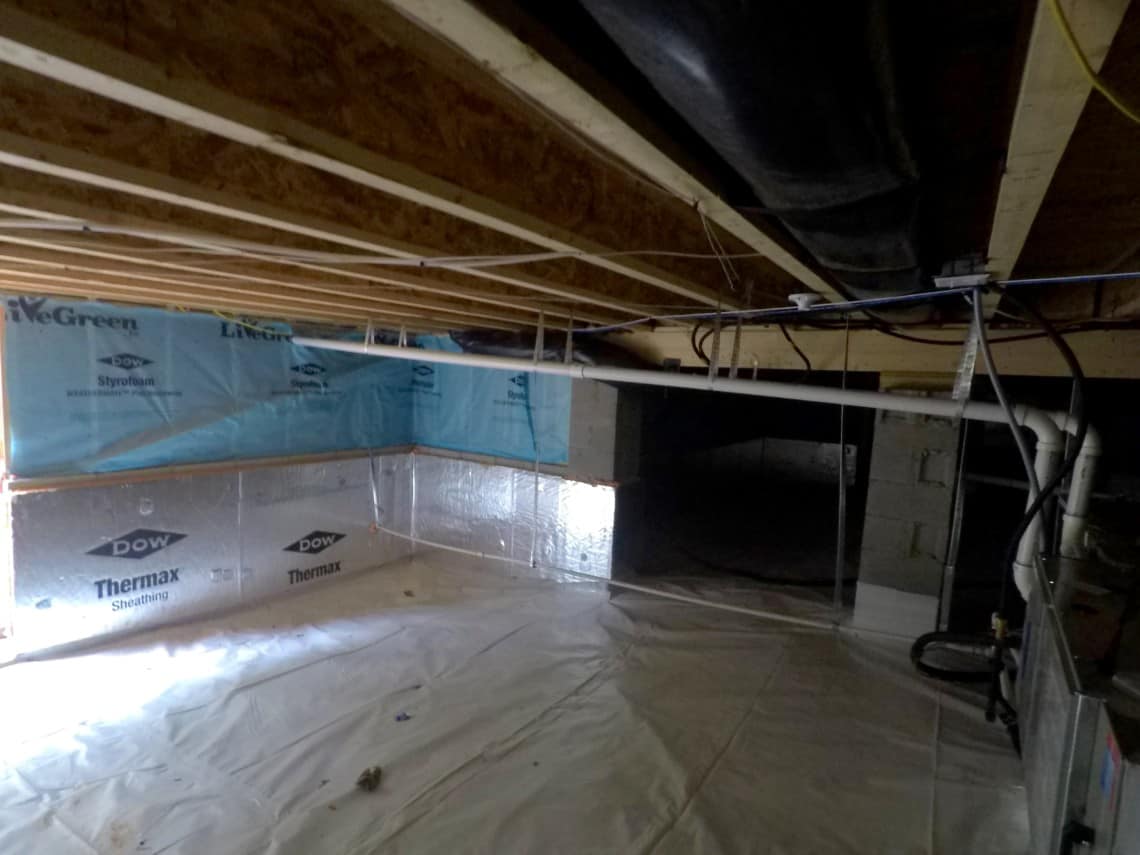
Sealed on the left, untreated on the right. Most of what you are paying for in the higher quote is the work you cannot see once the liner is down: sealed seams, wrapped piers, and a proper termination at the top of the wall.
The one comparison that is genuinely unfair
If one contractor went under your house with a moisture meter and another quoted from the driveway, those two numbers are not comparable in either direction. The driveway quote might be too low because it missed standing water, or too high because it padded for unknowns. Either way it is a guess. Insist that anyone quoting has actually been down there and can show you photographs of your own crawl space.
How to compare three quotes fairly
- Write the eight line items above down the side of a page and fill in what each quote says about each one. Gaps will appear immediately.
- Ask every contractor the same question: "what have you excluded from this price?"
- Ask for drainage to be priced separately rather than bundled, so you can see whether it is there at all.
- Ask what humidity level the finished space is expected to hold, and whether that is in the warranty.
- Ask to see photographs of your crawl space taken during the assessment.
- Check the warranty type — materials, workmanship, or performance — and get it in writing.
Do that and the three numbers usually stop looking random. In most cases they resolve into a ground cover, a partial encapsulation, and a complete one — and then it is a real decision about scope rather than a guess about who is trustworthy.
Common questions
Should I just take the cheapest quote?
Only if you have confirmed it covers the same work. Read the low quote against the eight line items above; if it is a floor liner with overlapped seams and no wall termination, it is a ground cover rather than an encapsulation. That may still be the right purchase on a tight budget, but you should know that is what you are buying rather than assume you found a bargain.
Is the most expensive quote always the most thorough?
No. Price and scope usually correlate but not always. A high quote can include equipment your house does not need, most commonly a dehumidifier specified by default rather than by design. Compare the line items in every direction, and ask why each inclusion is there.
How can two contractors disagree about whether I need drainage?
Usually because they visited in different conditions. A crawl space inspected during a dry fortnight looks very different from the same space two days after a storm. If drainage is in dispute, ask each contractor what evidence they saw, look for a tide line on the piers or silt patterns on the soil, and if it is still unclear, have someone look again after heavy rain.
Do I need a permit for crawl space encapsulation in North Carolina?
It depends on the jurisdiction and on what the work involves. Sealing a crawl space changes how it ventilates, and some work touching electrical or mechanical systems triggers permitting on its own. Ask each contractor how they handle permits and inspections in your city or county, and treat a contractor who dismisses the question as a warning sign.
What warranty should I expect?
Expect the type to be stated plainly. A materials warranty covers the liner itself failing. A workmanship warranty covers the installation. A performance warranty commits to holding a humidity level in the finished space, which is the closest thing to a promise about the outcome you are buying. Get whichever you are offered in writing, with the term and the exclusions.
Can I negotiate on scope instead of price?
Yes, and it is usually the more productive conversation. Staging the work in a sensible order, handling water and ground cover first and adding wall insulation or humidity control later, is a legitimate way to fit a budget. Removing the sealed terminations or the seam work to hit a number is not, because those are the parts doing the actual job.
Want a fourth opinion that shows its working?
We assess with moisture readings and photographs, and quote line by line so you can hold it against the others.
Get a Free EstimateOr call us directly at (919) 453-6411 · Monday–Friday 7 AM–5 PM
